
Every coring job starts the same way: a GPR scan across the area, a read from the technician, and a decision on where it is safe to drill. That part is not in question here. What follows is a look at five specific conditions, metal deck slabs, post-tension cables, curtain wall pinning, an already-approved rebar cut, and heavily congested slabs, where it is worth asking the scanning company one more question before the coring crew shows up. Not because the GPR read is wrong. Because in these five spots, that read is doing more work than usual, and it is worth knowing when to ask what is backing it up.
On nearly every job, GPR is the right call to start with. It is fast, non-invasive, and gives a technician a real-time picture of what is inside a slab before anyone commits to a cut. Nothing here argues for skipping it or replacing it with X-ray concrete scanning. A GC, PM, or superintendent does not need to second-guess that call, and choosing the scanning method is not a decision that belongs on the general contractor's side of the table in the first place. That decision sits with the scanning company. What is worth knowing is the handful of conditions where it is reasonable to ask a direct question about what backed up the read.
In a typical scan, GPR is hard to beat. A slab with a straightforward rebar grid and no unusual conditions can be read in ten to fifteen minutes, with a clean, confident result. That covers most jobs, and there is no reason to complicate them.
The read itself comes down to one technician interpreting reflections in real time, hyperbolas, signal strength, depth estimates, and judging what each one means against everything else in the slab. That is a real skill, built over years, not a formula. On a typical slab, that skill is more than enough.
On certain slabs, that same read carries more than a typical scan ever does. The conditions below are where a concrete X-ray scan ends up cheaper and safer than the cost of a read that turns out wrong, not because GPR failed, but because the slab itself pushed past what GPR alone can promise.


Composite metal deck slabs, PanDeck, Q-deck, and similar systems, sit a corrugated steel deck directly under the concrete topping. That steel reflects radar signal strongly enough to distort or mask what is happening in and above the flutes. It is not about the technician missing something or needing a slower pass. It is a physical limit in how GPR reads contrast in materials, and metal deck breaks that contrast in a way plain concrete and rebar do not.
On PanDeck and Q-deck work, that is less an occasional exception and more a standing reason to ask whether the read accounted for what is happening around the deck, or whether an X-ray machine for concrete confirmed it directly.

A post-tension cable does show up on a GPR scan, that is not in dispute. What is harder is telling it apart from a rebar hyperbola when the reflection sits close enough that only real experience can call the difference with confidence. A PT cable that reads like just another bar is an easy mistake to make, and an expensive one to get wrong.
Unlike most coring mistakes, a hit PT cable cannot be patched. It has to be replaced outright, cable and anchorage both. On a mid-construction high-rise, that replacement runs into the tens of thousands of dollars, on top of the schedule impact of accessing and re-tensioning it. Anywhere a GPR read shows something that could be a PT cable, a confirmed concrete X-ray scan settles the exact path before a bit goes through the slab.
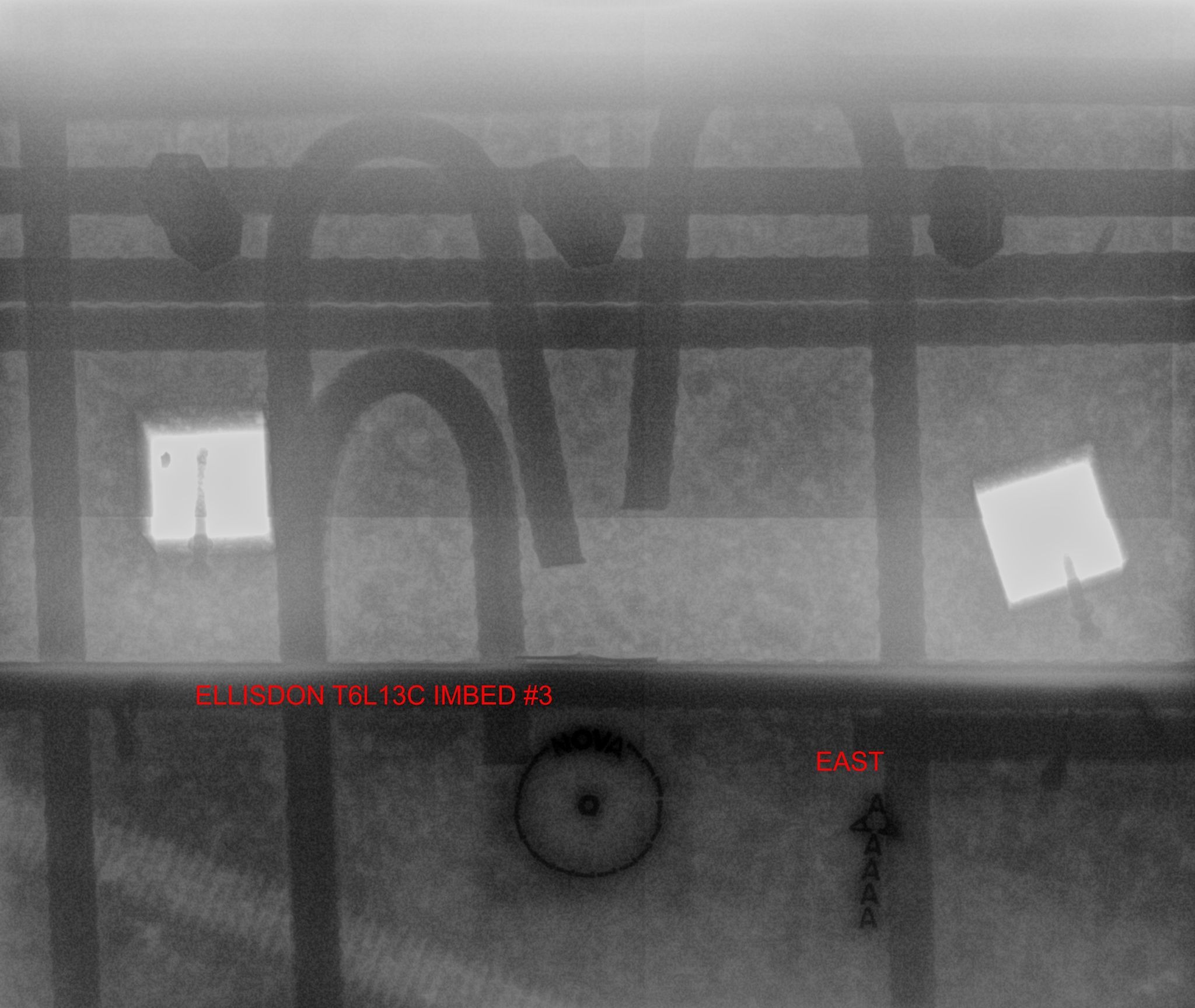
Curtain wall systems on high-rises come with prefabricated anchor plates, usually three bolt holes set in a fixed pattern. Once the first pin goes in, the second and third are not something anyone nudges over if they land wrong, the plate decides all three positions at once. That means the exact spot has to be confirmed before the first hole is drilled, with a tolerance that runs down to about an eighth of an inch.
That is tighter than a GPR read on a congested edge zone can reliably promise, and edge zones tend to be where embed density is highest. A confirmed position before the first pin commits the other two is worth asking for here.
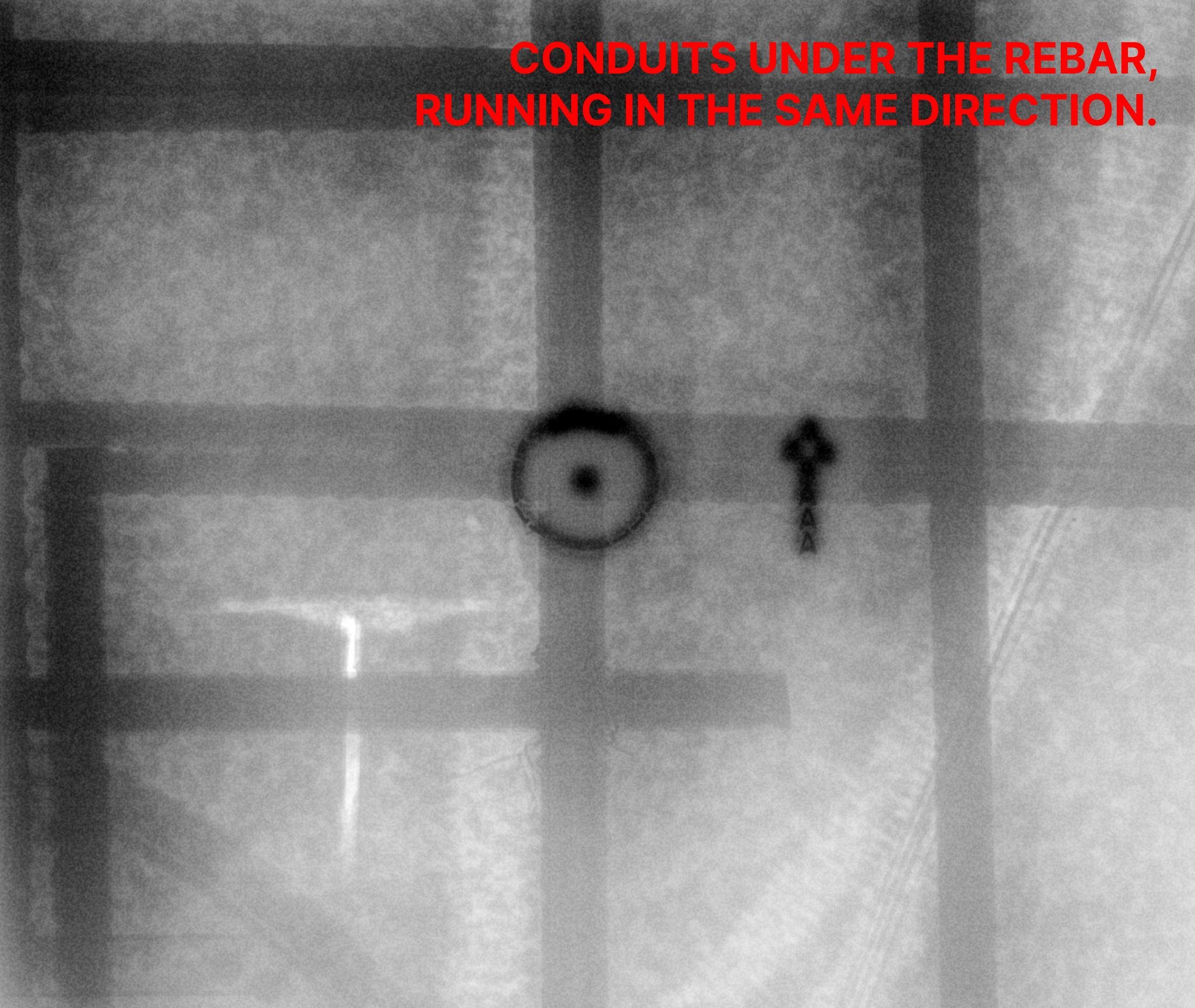
The standard rule on a suspended slab is simple: nothing gets cut that has not been planned for. So when an engineer has already approved cutting specific rebar to make room for a core, the risk is not hitting the bar, that part is expected. The risk is what is riding under or tied to it. Conduit run beneath rebar, or lashed directly to it, can sit close enough that its signal gets buried under the much larger rebar reflection on a GPR scan, effectively invisible.
This is the one case on this list where the goal is not avoiding an element, it is making sure an approved cut does not take something else with it. Worth a direct question before that cut happens.
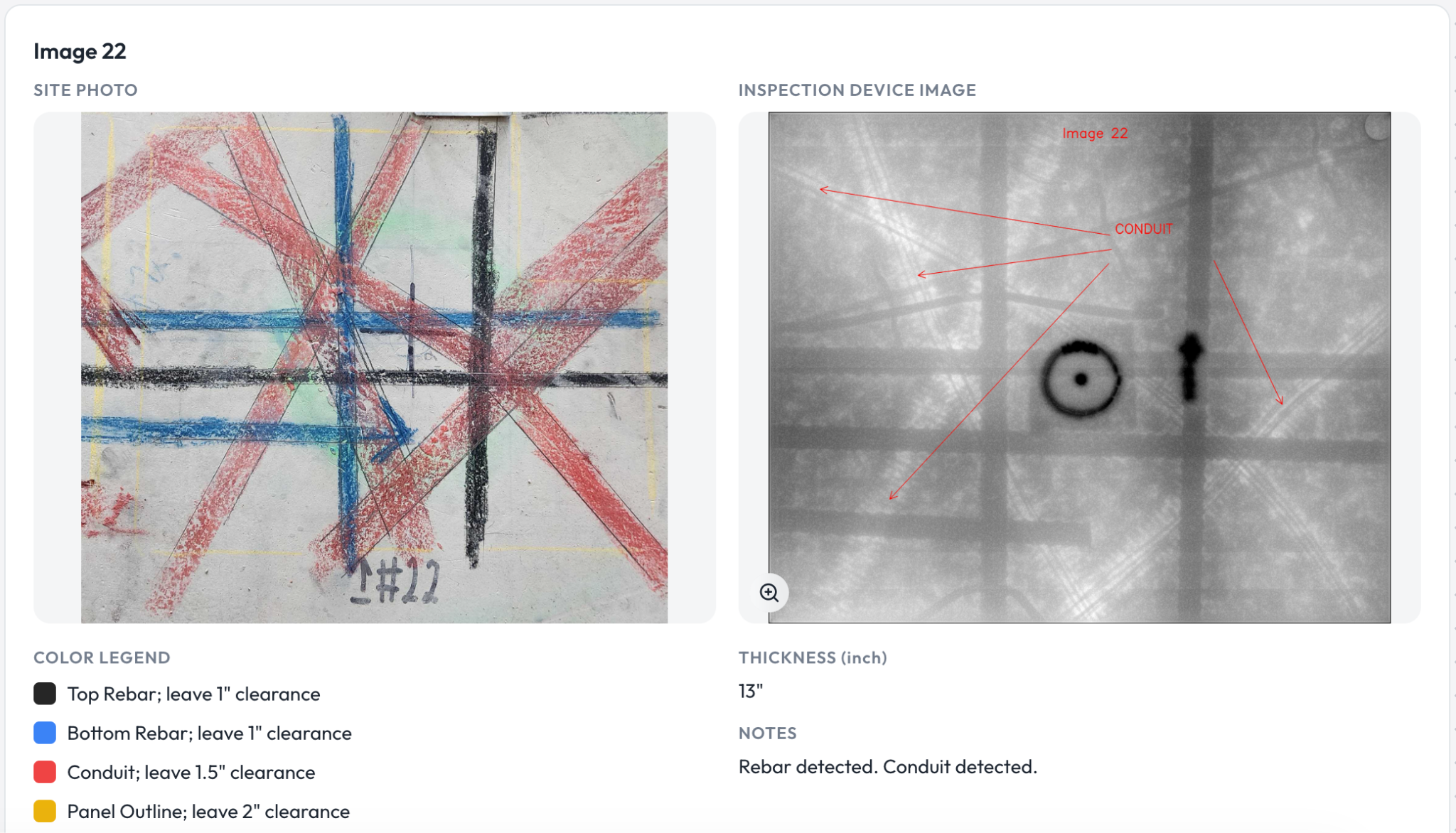
Some slabs do not have one problem spot, the whole area is the problem. A thick slab carrying two or three layers of rebar stacked over a dense run of conduit, with clearance requirements that keep a bit a couple of inches clear of certain elements, does not leave a clean zone to fall back on if a read comes back uncertain. At that thickness and with that much layering, GPR resolution starts working against the read rather than for it.
A concrete X-ray scan at that point is a small time cost measured against the cost of a wrong guess on a slab this dense, for the crew and for the client.
None of these five cases exist because a GPR technician might get it wrong. Good operators read slabs well, that is not in question here. What a confirmed concrete X-ray scan does is take the full weight of that call off one person's shoulders on the jobs where the cost of a mistake, a severed PT cable, a redrill through a load-bearing bar, a damaged conduit, an insurance claim, a delayed pour, is disproportionate to the few extra minutes a confirmation shot costs.
Nova technicians are trained and certified to the SNT-TC-1A standard for exactly this reason, so a second read, when one is asked for, carries the same weight as the first. That is not quality control layered over a technician's judgment. It is one less high-stakes decision resting on a single read.
Once a GC, PM, or superintendent can name which of these five conditions a job is standing in, asking about a confirmed concrete X-ray scan is not second-guessing the crew. It is just the next question on a short list. GPR still runs first on every job, no exceptions. The only thing that changes is knowing when it is worth asking what backed up the read.
Nova runs GPR and digital concrete X-ray in-house, on the same crew and the same visit, so getting X-ray for concrete confirmation does not mean bringing in an outside company. For a closer look at how the two methods actually compare, see this breakdown of concrete X-ray vs. GPR scanning, or how a confirmed X-ray held up on an active EllisDon site at Oakridge Mall. For what the process looks like end to end, this workflow walkthrough covers a real job site from setup to report. To talk through a specific slab, reach the Nova team directly.